Tom, whose choice this was, did not attend the book club, and our numbers were depleted. The Very Annoying Man was at last away on his cruise, which he had been talking about for the previous three meetings. Some of the book club could not understand the book at all, and everybody found it gloomy. But one - new - lady had read an introduction by James Wood, and this had moved her to consider the book more carefully. She asked, in a roundabout way, if Sebald was actually writing for other academics, and whether this is an example of high art, as opposed to commercial art, to which I was able to reply, Yes. The book is a challenge; it makes you work; you don't have to agree with it all; the whole purpose of it is to put the Nazi operation at Theresienstadt into some kind of context and to present those events to an audience, to deny the desire to forget.
I thought of my friend Debbie's Dad, George. He came over from Prague on the kindertransport. He was not in the least like Austerlitz - he seized the day. Right up until his final illness he shopped, cooked, played classical pieces on the piano, listened to cool jazz and played bridge. His great enjoyment was seeing his family tucking into some great casserole he had cooked up. I believe in his professional life he had been a very successful engineer. He had married and had four children, who had travelled far and wide and also been successful in creating good lives for their own children. Georg didn't spend any time being bitter about things in spite of the fact that he had no family left, apart from one cousin in America. The rest - their names are written on the wall of the memorial synagogue in Prague.
We should really think about this in view of the fact that the UK has been asked to find places for 3,000 unaccompanied child refugees from Syria - and the government has said No!!! I can't believe it. I would take two. I wonder if there is a petition I can sign.
Oh I forgot to say: we voted on the book and gave it 5 out of 10; so much for high art! I gave it a higher score as it was, at least, interesting.
Showing posts with label Austerlitz. Show all posts
Showing posts with label Austerlitz. Show all posts
Sunday, 7 February 2016

Friday, 22 January 2016
Austerlitz Part 3
Austerlitz, having had a nervous breakdown, is now in a state of mind where he can begin to remember his life before he came to Wales. Prior to this time he had gone to some lengths to keep away from contemporary history, to remain ignorant of it.
He becomes endearingly obsessed with a longing to see an image of his mother.
It seems that Sebald may be saying that we must not deliberately forget something that happened, not long ago, in Europe, and if we do, it will give us a collective nervous breakdown like that which Austerlitz suffers in this novel. Is this something he aims particularly at the German nation, or at everyone? In Nuremberg, Austerlitz says: "I was troubled to realize I could not see a crooked line anywhere, not at the corners of the houses or on the gables, the window frames of the sills, not was there any other trace of past history."!! In the Germans' defence this town was bombed to rubble in the war and they could hardly put destroyed medieval timbers back again, and also, there is a massive memorial and museum just a bus ride away.
The account of the Theresienstadt Ghetto/camp we are given, in one long sentence, contains no adjectives as the facts speak for themselves. The evil of the intent and the thoroughness put into ensuring its enactment are bewildering.
At the end of the book Austerlitz is in Paris looking for evidence that his father was there. At one time he decides to do some research in the Biblioteque nationale de France.
Austerlitz describes how difficult it is to get in to this building and how unfit for purpose it seems. Once again, the grand scheme defeats and humiliates the individual and doesn't respond to his/ her needs. We seem to have learned nothing.
"The new library building, which in both its entire layout and its near ludicrous internal regulation seeks to exclude the reader as a potential enemy, might be described, so Lemoine thought, said Austerlitz, as the official manifestation of the increasingly importunate urge to break with everything which still has some living connection to the past."
And there commences an account of the theft of all the belongings of the Parisian Jews who were interned prior to their transport to the east - and on the site of the warehouses used to store all their stolen cutlery and clothes - stands this biblioteque.
He becomes endearingly obsessed with a longing to see an image of his mother.
Austerlitz himself is almost the embodiment of post-Holocaust trauma. So affected is he by the fate of his parents and family that he lives an isolated life, unable to turn from his acquired memories – for his parents fate has become his own. His alienation from other people is now so complete that he is unable to form relationships with other people.
The Common Reader blog
It seems that Sebald may be saying that we must not deliberately forget something that happened, not long ago, in Europe, and if we do, it will give us a collective nervous breakdown like that which Austerlitz suffers in this novel. Is this something he aims particularly at the German nation, or at everyone? In Nuremberg, Austerlitz says: "I was troubled to realize I could not see a crooked line anywhere, not at the corners of the houses or on the gables, the window frames of the sills, not was there any other trace of past history."!! In the Germans' defence this town was bombed to rubble in the war and they could hardly put destroyed medieval timbers back again, and also, there is a massive memorial and museum just a bus ride away.
The account of the Theresienstadt Ghetto/camp we are given, in one long sentence, contains no adjectives as the facts speak for themselves. The evil of the intent and the thoroughness put into ensuring its enactment are bewildering.
At the end of the book Austerlitz is in Paris looking for evidence that his father was there. At one time he decides to do some research in the Biblioteque nationale de France.
 |
| This is it. All four of those towers form the Grande Biblioteque. |
 |
| Inside the box framed by the four towers are fully-grown trees. |
"The new library building, which in both its entire layout and its near ludicrous internal regulation seeks to exclude the reader as a potential enemy, might be described, so Lemoine thought, said Austerlitz, as the official manifestation of the increasingly importunate urge to break with everything which still has some living connection to the past."
And there commences an account of the theft of all the belongings of the Parisian Jews who were interned prior to their transport to the east - and on the site of the warehouses used to store all their stolen cutlery and clothes - stands this biblioteque.
Austerlitz, by W.G. Sebald, Part 2
This book is presented as one long paragraph of writing, and this is cleverly contrived. One thing leads to another so that most of the time one can't find a place where a paragraph break should go. On the other hand, Sebald occasionally cheats by using a dash - to show a new thought. Just as one sentence slides onto the next, the narrator and Austerlitz slide into one another, because we get Austerlitz's narrative always at second hand, and the narrator seems to have no particular personality of his own. He is more like a shadow. Perhaps he is a ghost?
...
In Austerlitz's stories it seems always to be twilight, there is dust in the air, a sense of unreality. So one ponders for a while when reading: " Only at Liverpool Street station, where he waited with me in McDonald's until my train left..." because it seems that neither of these characters could be seen in such a uniform, utilitarian place as McDonald's! even if they were casually remarking on the "glaring light".
It turns out that Austerlitz lives in Alderney Road, (near Queen Mary's University) in the Mile End. Naturally, when the narrator goes to visit him it is dusk. "This room too contained hardly any furniture; there were just the grey floorboards and the walls in which the light of the flickering blue flames was now cast in the gathering dusk. I can still hear the faint hiss of the gas, I remember that while Austerlitz was making tea in the kitchen I sat entranced by the reflection of the little fire....."
After he gives up teaching, which had been his profession for thirty years, Austerlitz intends to write his book. He has been collecting material about various aspects of architecture for many years, but when he comes to write the book, he can't do it.
Time, said Austerlitz in the observation room in Greenwich, was by far the most artificial of all our inventions, and in being bound to the planet turning on its own axis was no less arbitrary than would be, say, a calculation based on the growth of trees or the duration required for a piece of limestone to disintegrate, quite apart from the face that the solar day which we take as our guideline does not provide any precise measurement, so that in order to reckon time we have to devise an imaginary, average sun which has an invariable speed of movement and does not incline towards the equator in its orbit. If Newton really thought that time was a river like the Thames, then were is its source and into what sea does it finally flow? Every river, as we know, must have banks on both sides, so where, seen in those terms, where are the banks of time? ...
...
Even in a metropolis ruled by time like London, said Austerlitz, it is still possible to be outside time, a state of affairs which until recently was almost as common in backward and forgotten areas of our own country as it used to be in the undiscovered continents overseas. The dead are outside time, the dying and all the sick at home or in hospitals, and they are not the only ones, for a certain degree of personal misfortune is enough to cut us off from the past and the future... I have never owned a clock of any kind...perhaps because I have always resisted the power of time out of some internal compulsion which I myself have never understood, keeping myself apart from so called current events in the hope, and I now think, said Austerlitz, that time will not pass away, has not passed away, that I can turn back and go behind it, and there I shall find everything as it once was, or more precisely I shall find that all moments of time have co-existed simultaneously, in which case none of what history tells us would be true, past events have not yet occurred but are waiting to do so at the moment when we think of them, although that, of course, opens up the bleak prospect of ever-lasting misery and never-ending anguish.
In Austerlitz's stories it seems always to be twilight, there is dust in the air, a sense of unreality. So one ponders for a while when reading: " Only at Liverpool Street station, where he waited with me in McDonald's until my train left..." because it seems that neither of these characters could be seen in such a uniform, utilitarian place as McDonald's! even if they were casually remarking on the "glaring light".
It turns out that Austerlitz lives in Alderney Road, (near Queen Mary's University) in the Mile End. Naturally, when the narrator goes to visit him it is dusk. "This room too contained hardly any furniture; there were just the grey floorboards and the walls in which the light of the flickering blue flames was now cast in the gathering dusk. I can still hear the faint hiss of the gas, I remember that while Austerlitz was making tea in the kitchen I sat entranced by the reflection of the little fire....."
After he gives up teaching, which had been his profession for thirty years, Austerlitz intends to write his book. He has been collecting material about various aspects of architecture for many years, but when he comes to write the book, he can't do it.
Now and then a train of thought did succeed in emerging with wonderful clarity inside my head, but I knew even as it formed that I was in no position to record it, for as soon as I so much as picked up my pencil the endless possibilities of language, to which I could once safely abandon myself, became a conglomeration of the most inane phrases. There was not an expression in the sentence but it proved to be a miserable crutch, not a word but it sounded false and hollow. And in this dreadful state of mind I sat for hours..."And then this malaise spreads itself so that he can no longer read.
If language may be regarded as an old city full of streets and squares, nooks and crannies, with some quarters dating from far back in time while others have been torn down, cleaned up and rebuilt, and with suburbs reaching further and further into the surrounding country, then I was like a man who has been abroad a long time and cannot find his way through this urban sprawl any more, no longer knows what a bus stop is for, or what a back yard is, or a street junction, an avenue or a bridge. The entire structure of language, the syntactical arrangement of parts of speech, punctuation, conjunctions and finally even the nouns denoting ordinary objects were all enveloped in impenetrable fog. I could not even understand what I myself had written in the past - perhaps I could understand that least of all. All I could think was that such a sentence only appears to mean something, but in truth is at best a makeshift expedient, a kind of unhealthy growth issuing from our ignorance, something which we use, in the same way as many sea plants and animals use their tentacles to grope blindly through the darkness enveloping us.Austerlitz is haunted by the past in Liverpool Street station.
Whenever I was in the station, said Austerlitz, I kept almost obsessively trying to imagine - through the ever-changing maze of walls - the location in that huge space of the rooms where the asylum inmates were confined, and I often wondered whether the pain and suffering accumulated on this site over the centuries had every really ebbed away, or whether they might not still, as I sometimes thought when I felt a cold breath of air on my forehead, be sensed as we pass through them on our way through the station halls and up and down the flights of steps.On this station Austerlitz has a vision which has the greatest significance for him, and this is the end of the first part of the book; for the rest of the book deals with his journey to find out his origins. This he has delayed for too long, for at this point he is soul-sick and he has to, needs to go to find some kind of healing.
Austerlitz by W G Sebald, Part 1
If I said that I had been very cast down by reading these gloomy ramblings, it would be true, but I do want to see that this book is worth reading and thinking about. Firstly, the tone is never at all jocular or witty, which is difficult for me, but it is always neutral, and if I find the style gloomy it is my personal response to the prose. The book is translated from the German and it may be that even in German the style is old-fashioned and "high". And the story could best be described as discursive, so for example, when we have Austerlitz's friend's uncle telling us about the life cycle of moths one sighs a bit and feels led up the garden path. However:
The narrator, and the Austerlitz of the title, travel to several European cities in the course of this narrative, and the story is an international one, about the history of Europe in the age of capitalism. The writer describes a number of buildings and engineering works that illustrate the idea that history is all around us (just as the Rings of Saturn are decayed and destroyed moons of Saturn.)
The narrator is interested in buildings and the first pages he describes his visit to the fort at Breendonk in Belgium. In WWII the Nazis used it as a prison camp and it is preserved - as a memorial - as it was when the Germans vacated it in 1944. It includes a torture chamber.

Having read the book and understanding a little about what it is about - it is about the mass-murder of the Jews by the Nazis but it is also about the history of Europe - I am going back through it again to try to understand what is meant by the buildings that are featured in the novel. We start with the beautiful railway station in Antwerp and its grandiose ambitions . This is where the narrator first meets Austerlitz, an architectural historian who studies in London.
Austerlitz then talks about his explorations of the labyrinth inside the Palais de Justice in Brussels, a building in which there are so many corridors and storeys, so many stairways and doorways, that many rooms are mysteriously half furnished and unused.
"the architectural style of the capitalist era, a subject which he said had fascinated him since his own student days, speaking in particular of the compulsive sense of order and the tendency towards monumentalism evident..."
Then the narrator meets Austerlitz again in the Great Eastern Hotel, near Liverpool Street Station. I don't have any personal experience of this station or this hotel, but perhaps I should! Here is the station:

And here is the hotel:
And here is the Masonic Temple inside the hotel - is this significant, I wonder, in Austerlitz's thesis of monumental architecture?
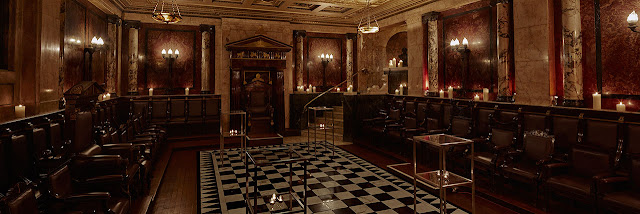
Austerlitz describes this: "a hall with walls panelled in sand-coloured marble and red Moroccan onyx, a black and white chequered floor, and vaulted ceiling with a single golden star at the centre emitting its rays into the dark clouds all around it."
Austerlitz had been brought up in a very gloomy and silent home by Lake Bala in Wales.
His adoptive father was a fire and brimstone preacher whose own family home was a village called Llanwddyn, which was drowned when the valley was flooded to create an enormous reservoir needed to supply water to Liverpool. So the creation of the lake Vyrnwy , like the buildings described earlier, sacrificed small scale domestic lives to the greater good - or rather, of very large conurbations created by the forces of capitalism.
Have a look at these wonderful pictures of Victorian engineering.
When he was told about his father's lost home, Austerlitz felt something approaching empathy with his adoptive father, because he knew nothing about his own early years: they too were buried, but buried in his mind. The father's childhood places were deeply submerged in water but sometimes he can see his village through the water - as we can sometimes see the past in what is existent.
Luckily Austerlitz makes friends with another boy at his boarding school with whom he can spend his holidays as his "mother" dies of a mysterious fading away, and his father ends his days in an asylum.
After this Austerlitz discourses on the subject of time, and I shall write about that in the next post.
NOTE: by using these illustrations I have made Sebald's book more attractive. The illustrations he himself chose are black and white, and lend themselves to historical meditation about time and place more than admiration for the places he describes.
The narrator, and the Austerlitz of the title, travel to several European cities in the course of this narrative, and the story is an international one, about the history of Europe in the age of capitalism. The writer describes a number of buildings and engineering works that illustrate the idea that history is all around us (just as the Rings of Saturn are decayed and destroyed moons of Saturn.)
The narrator is interested in buildings and the first pages he describes his visit to the fort at Breendonk in Belgium. In WWII the Nazis used it as a prison camp and it is preserved - as a memorial - as it was when the Germans vacated it in 1944. It includes a torture chamber.

Having read the book and understanding a little about what it is about - it is about the mass-murder of the Jews by the Nazis but it is also about the history of Europe - I am going back through it again to try to understand what is meant by the buildings that are featured in the novel. We start with the beautiful railway station in Antwerp and its grandiose ambitions . This is where the narrator first meets Austerlitz, an architectural historian who studies in London.
 |
| Exterior of station |
 |
| Interior. Really, it's so beautiful I don't care how sinister are the implications of its monumentalism. |
Austerlitz then talks about his explorations of the labyrinth inside the Palais de Justice in Brussels, a building in which there are so many corridors and storeys, so many stairways and doorways, that many rooms are mysteriously half furnished and unused.
 |
| Palais de Justice in Brussels "contains corridors and stairways leading nowhere" |
 |
| Inside the Palais de Justice |
Then the narrator meets Austerlitz again in the Great Eastern Hotel, near Liverpool Street Station. I don't have any personal experience of this station or this hotel, but perhaps I should! Here is the station:

And here is the hotel:
 |
| Great Eastern Hotel |

Austerlitz describes this: "a hall with walls panelled in sand-coloured marble and red Moroccan onyx, a black and white chequered floor, and vaulted ceiling with a single golden star at the centre emitting its rays into the dark clouds all around it."
Austerlitz had been brought up in a very gloomy and silent home by Lake Bala in Wales.
 |
| Lake Bala. As Austerlitz's childhood was grey and silent I have chosen this grey evening photo. |
His adoptive father was a fire and brimstone preacher whose own family home was a village called Llanwddyn, which was drowned when the valley was flooded to create an enormous reservoir needed to supply water to Liverpool. So the creation of the lake Vyrnwy , like the buildings described earlier, sacrificed small scale domestic lives to the greater good - or rather, of very large conurbations created by the forces of capitalism.
Have a look at these wonderful pictures of Victorian engineering.
 |
| Lake Vyrnwy |
Luckily Austerlitz makes friends with another boy at his boarding school with whom he can spend his holidays as his "mother" dies of a mysterious fading away, and his father ends his days in an asylum.
 |
| View of Arthog Estuary near the house where Austerlitz spent his holidays. |
 |
| On this bridge Austerlitz, Adela and Gerald sat at twilight, looking out to sea. |
NOTE: by using these illustrations I have made Sebald's book more attractive. The illustrations he himself chose are black and white, and lend themselves to historical meditation about time and place more than admiration for the places he describes.
Subscribe to:
Posts (Atom)