Showing posts with label Etonians. Show all posts

Sunday, 8 November 2015

Hugh's War on Waste

Hugh Fearnley-Whittingstall is looking into the way we waste food - not just we consumers, but also the supermarkets. At present this campaign isn't very popular. People don't like to be told to make a bit more effort rather than throw things away.

Have a look at his website for his top tips. Reduce - Re-use - recycle!  But especially reduce.


Here is a link to a petition asking supermarkets to account for their waste.Sign the petition

Hugh honestly believes that when he exposes the truth about waste, people will start to reform their behaviour. Actually, they say to him, "oh, that's terrible, I had no idea" because it's easier than saying they know perfectly well but they don't really care. But he demonstrates persuasiveness.

I love his sense of purpose and his understated confidence.

Envious of his garden achievements

My cookbook

What is interesting about Hugh is his assumption that he has a voice that people will listen to. This is an example of an Eton education  being used for something that isn't propping up the established way of doing business. But let us look at other Eton alumni who do the same thing. There is Jonathan Porritt, founder of Friends of the Earth. There are Justin Welby, the Archbishop of Canterbury, Sir Ranulph Feinnes, explorer, Perry Anderson, editor of New Left Review (never heard of him), Patrick Hennessy, Deputy Director of Communications for the Labour Party, Nicky Gumbel, founder of the Alpha movement in the C of E, and many others.

 Zac Goldsmith was not at Eton for long, (can't help but wonder why) but he is a good example of someone who campaigns on alternative ideas despite having a vested interest in the status quo, in that he inherited hundreds of millions of pounds. He is a campaigner for sustainability and a longtime donor to the Soil Association, and he welcomes Direct Democracy (getting people to vote on specific issues). (I'm a pushover for Zac, who is handsome and civilised.

There are many, many old Etonians who have a voice, and many of them are actors. Why is Eton producing so many actors? It used to produce writers, journalists and politicians as well as lawyers and businessmen. Actors are all very well but we don't need them all, Nicholas Rowe, Dominic West, Damian Lewis, Tom Hiddleston, Eddie Redmayne and many more whom we haven't yet heard of. Some of them are even becoming comedians, again, this shows that they believe that when they speak, people will listen, and they probably do.

Wednesday, 5 August 2015

John Steinbeck, George Orwell and Russell Brand

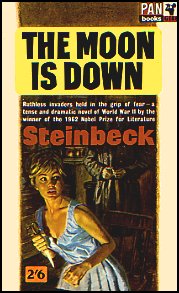
On the plane I read an old book I've had on my shelf for a long time: "The Moon Is Down" by John Steinbeck. This book has the simplest grammar and vocabulary of any book I have read that wasn't a graded reader for learners of English, or children learning to read. I admire John Steinbeck because he compromised between his talent and his desire to be read by the people - the people who were the ordinary Joes who fought in the war, and the marginalised people he gave a voice to in "Cannery Row".Previous entry on Cannery Row . well, perhaps he didn't compromise, perhaps he just adapted his talent, so that anyone could read his books, and when Pan sucked the readers in by giving the cheap paperbacks sexy covers, he probably didn't mind.

anyway,this short novel is on the theme of the bravery of citizens when their land is invaded by the Germans - not the   French but the Norwegians - how each individual makes up his/her mind about collusion and how the   invaders feel about their position as unwelcome strangers - Steinbeck treats them quite sympathetically : he knew folks are just folks.

Another writer who adapted his style to write for a mass readership was George Orwell. "Animal Farm" and "1984" are books designed to teach you something, without the writer giving you a sermon. He gives you a parable or analogy instead, something you can understand. In his journalism Orwell disciplined himself to write in words that anyone could understand. If you are reading this and you have not read any books by George Orwell I urge you to read "Animal Farm" as an example. His vocation was to communicate with people who did not have the benefit of a good education - Orwell went to Eton and that is generally recognised as a "good" education- (the teaching is excellent but there are no girls - is that a problem?)

Orwell came into my mind because I was reading "Revolution" by Russell Brand, and he quotes from "Homage to Catalonia" which is Orwell's account of his involvement in the Spanish Civil War. He quotes several passages so you get the flavour of Orwell's absolutely plain prose.

In outward appearance it was a town in which the wealthy classes had ceased to exist. Except for a small number of women and foreigners there were no "well-dressed" people at all. Practically everyone wore rough working-class clothes or some variant of militia uniform. All this was queer and moving.
Russell Brand cannot do this. He cannot let go of his desire to show off all that he knows, all the polysyllabic code that allows him to move amongst the intellectuals, but neither can he let slip all the buffoonery and the obscenity that marks his status as a top streetwise guy. The mixture should be fun and interesting, and to a certain extent it is, but there were many jarring notes in this work, the sort of discordant lack of taste that makes something abhorrent to me. Of course this is my opinion only. For readers of English as a foreign language this book is completely incomprehensible as it is written in a mixture of codes which are all sophisticated ones.