Showing posts with label Queensland. Show all posts

Wednesday, 7 October 2015

Belatedly - Fitzroy Island


Since with F we did the Ocean Spray trip, with Stan we also went out to the Great Barrier Reef, but more economically we took a morning ferry to Fitzroy Island. It was amazing. If there is one day I would like to remember it is the day we went there. The island isn't far from Cairns and the trip is very enjoyable. When you arrive you can go and hire snorkel gear or canoes, or whatever you want from the dive shop. They make you sign several documents to say whatever happens to you, it's your fault and not theirs, and if you damage any equipment you will pay for it. Having done that you are free to go wherever you want and nobody is going to come and save you if you do something stupid. So we had a fantastic time and saw marvellous coral and fish - even schools of small fish, and many brightly coloured single fish, and I saw a small ray on the bottom but I disturbed it.


It is exactly like this.

I don't have the equipment to take pics like this, but the coral was lovely!
We were going to walk on the rainforest path but it was slow going and we had already walked in lots of forests, so we stuck to the coast.

Tuesday, 1 September 2015

Plants of the Wet Tropics, North Queensland - creepers and climbers


You will not find a creepier creeper

Horribly prickly palm creeper: wait-a-while


Climbing pandanus


This is called a strangler vine. Eventually it will kill the tree.
Monstera was the first plant I was ever given! Here is a really happy one.

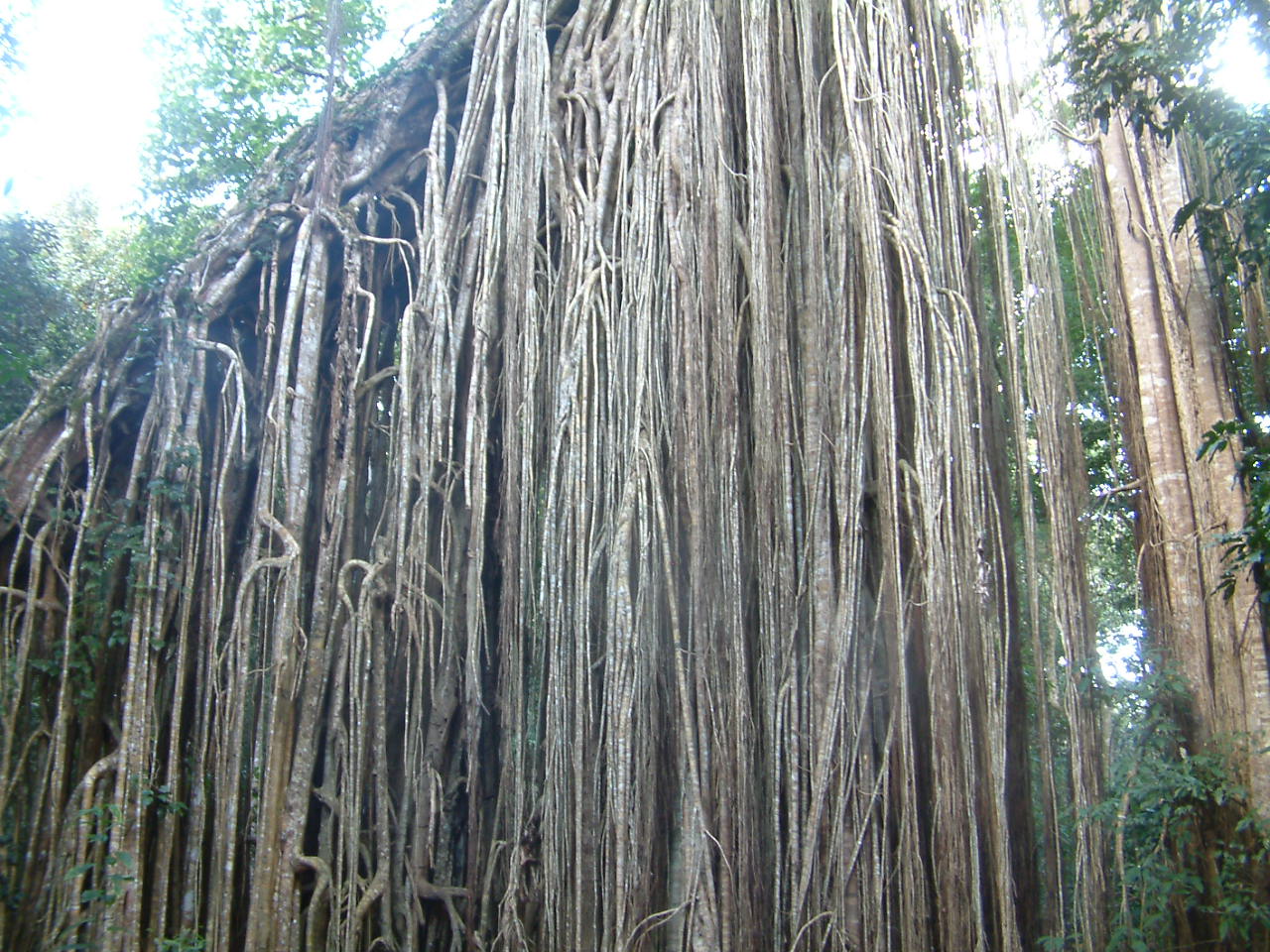
Plants of the Wet Tropics - more from North Queensland: Paperbark, palms, curtain fig tree

This is a giant red paperbark, botanical gardens Cairns. The point of the boardwalk, we discovered, is to stop the leeches which do lurk everywhere in a rainforest.
Paperbark


Strange lack of roots. Eaten away?


Saturday, 29 August 2015

Plants of the Wet Tropics - North Queensland - Kauri Pine and Hoop Pine

These tall (up to 50m), straight trunked, high altitude rainforest trees are the largest conifers in Australia. What is really strange is that they have leaves - thick elongated, oval; glossy green above and paler underneath. These trees bear both male and female cones. The smaller male cones appear in November and the larger, rough green globular cones develop in December and January. The female cones contains several winged seeds. The fruit is eaten by Sulphur-crested cockatoos.


This is supposed to be a Hoop Pine -the bark is often impregnated with resin. But it doesn;t look like the picture in the field guide. this is the problem with labels and field guides.


Plants of the wet tropics - North Queensland - ferns and cycads

Here you can see a number of epiphytic ferns growing on a tree in the rainforest

Ferns growing on a palm tree, North Queensland
The plants of Queensland: Bill Bryson explains:

The Daintree forest is a remnant of a time when the world was a single land mass, the whole covered in steamy growth. [The single land mass is called Pangea.] As time passed, continuents split up and drifted off to the far corners of the globe, but the Daintree [and the rest of N.Queensland], through some tectonic fluke, escaped the more dramatic transformations of climate and orientations that spurred ecological change elsewhere. In consequence, there are plants out there - whole families of plants - that survived as nowhere else. In 1972, scientists began to appreciate just how ancient and exceptional Australia's northern rainforest is when some cattle mysteriously sickened and died after grazing in the jungle's lower slopes. The cows, it turned out, had been poisoned by the seeds of a tree called Idiospermum australianse. What was unexpected about this was that Idiospermum was thought to have vanished from the earth 100 million years ago. In fact, it was doing very well in the Daintree, as were eleven other members of its family, a primitive outpost of botany called the angiosperms, from which all flowering plants are descended.

Campsite, Cairns. I think this is an Elkhorn Fern. These grow in rainforests and other moist forests on trees and rocks from a rhizome which is protected by nest leaves that enclose the base of the plant. The shield fronds are deeply lobed, whilst the fertile fronds stand semi-erect or nodding, and become pendulous with age.


This could be a Bird's nest fern or it could be the same as the above. It shows how they get started. 

I think this one at the bottom is a scaly tree fern. These fast-growing ferns grow up to 15m and have very slender woody trunks thickened at the base with distinctive oval leaf scars. The leaves can be up to four metres long.

What kind of cycad is this? Not sure but these have separate male and female plants with the reproductive structures arising from the centre of the plant. This, I think, is a male cone.


These pictures are from Rockhampton Botanicals which are gorgeous and very informative and entirely free to visit. I am copying information from a field guild by Martin Cohen and Julia Cooper. Sadly only one picture per plant which isn't ideal.


This is the information board in the botanicals in Mackay - very helpful, hope you can read it.


Another cycad (on the left)

Saturday, 15 August 2015

The Great Barrier Reef - "Ocean Spirit" from Cairns

"Ocean Spirit" turned out to be a gorgeous catamaran with 3 large sails. We got on, time for tea, coffee, and cakes, and when we put to sea it was time for the safety talk - by a French dive master - he had some natural authority - I was really impressed by his presentation in English - he gave us all the information about the snorkels and masks and fins and what to do with them, wet suit hire (which we didn't go for, but there was an option to go diving) and the UV protection suits (would have been a good idea but we were a bit blase). I had to stay on the deck for the sea-journey because it was a bit rough - I need to keep my eye on the sea to prevent being sick - but it was great; I have never seen such a blue sea and I kept taking pics of all the different blues.

Can't access my pics from here so here's a Winslow Homer!

In the lounge an attractive marine biologist gave a talk on types of fish and the island - Michaelmas Cay. This turned out to be a reserve for seabirds - there are tens of thousands of them - and tourists are not allowed near them; we were to stay in a small area of the white sandy beach. It also turned out that the wind there is very strong, and with the smelly birds and the sandblasting nobody would want to spend much time on the beach. I took a book with me and the pages became separated and the spine swollen with sand forced in.

It turns out that I am fine with snorkelling kit (no probs with mask which had nose covered: it was really good) but almost immediately we got in the sea and started to see the fish we went in different directions because were so distracted. Not wanting to hit the coral with my fins I hardly used them but F went off like a rocket as she is very fast with fins on. The most prolific coral just there was the one that looks like living spaghetti - a very active coral that lives close to the surface. There were prettier ones; like a branching one with purple tips and green sparkly bits, and the clam with outrageous lips. there was a strange clam with frilly white openings - two different shapes. There were no schools or shoals of large fish at that place but there were some beautifully coloured "loners"; I can't describe them exactly but they have "art deco" colours in striking patterns; they look very modern and you just want to stay still and study them but you can't.

We went and lay on the beach for a while and discussed what we had seen and how hard it was not to touch the coral and discussed the skill required to go slowly and watch more. After about twenty mins we went back in the sea, intending to stay together, and F and I managed to do this for a while, until she started to dive down in the deep parts (very fit our girlie). I stayed in the sea as long as poss but we had a deadline for lunch and had to catch the ferry back to the boat. We got dry enough to go into the saloon and had hot food (vegetarian curry - lovely) and a chilled buffet of salads.

Another activity on offer was a trip in a semi-submersible; a launch tightly-packed below like a row of bus-seats, where we could navigate between the banks of coral and get a good view of it all through the glass walls.  That was excellent for people who weren't up to snorkelling (or even getting wet).

Back on the boat there were cakes and coffee, and we had a stiff wind and a rough-ish sea back to the land, and the catamaran went up and down far more than it progressed towards the shore. About 20 people were properly sick, but the smartly-dressed crew went about distributing, collecting, and disposing of sick bags in a very professional way. I sat still and kept my eyes on the horizen as much as poss for the three hours it took to get back to the harbour. It made me very sunburnt and tired. I especially got burnt whilst I was snorkelling around my bum and the backs of my legs which have not see much sun for many years. I am being a brave soldier because actually it was all fantastic. When we came into harbour we even got a glass of bubbly.

Before we go home we want to go for another reef trip. The reef is the greatest living thing in the world and we are so lucky to have visited - what a fantastic trip.