I have read this book before but I think I skipped the diaries as they made me feel so cast down. There is a downbeat note to them. A dying fall. I love his writing in that it's well structured and elegant, I seem to agree with his sentiments quite consistently, but the way he writes is not cheering. I feel as though my head has been buried in a vat of mud. He is brave though, in that he confronts, amongst other things, the awfulness of our old people's homes. His latest play is set in such a home and I think I should go and see it. Perhaps he has changed his mind about such places.
Untold Stories begins with an account of Bennett's mother's mental illness - delusions caused by depression. I suppose such a frank account is rare. My daughter is about to spend a year studying psychiatric illness and medicine and it is on the reading list supplied by the medical school. I think it will also help her to understand what kind of mindset older people may have: that is: they may not have travelled much, have very modest aspirations, be very suspicious of new and foreign things, and yet make a big deal of themselves, express strong pride in their family, their hometown, the people they know.
Showing posts with label dementia. Show all posts
Showing posts with label dementia. Show all posts
Thursday, 6 September 2018

Wednesday, 7 October 2015
The Dementia clinic
The dementia clinic is called the Memory Clinic because nobody likes the word dementia. Perhaps Alzheimer's would be better? My mother has Alzheimer's and yesterday I had to take her to the clinic to see a nurse, to be assessed, and a report will be written about her and sent to her G.P. I appreciate this. The G.P. has not got time to bother with this kind of care, and so it is done by specialists. If a better medicine is found for Alzheimer's I am sure my mother will get it.
The nurse talked to my mother about her life and her habits, and suggested that she go to the Day Centre in order to have more company. My mother had tried the day centre a couple of times and hated it. She said people just sit and look at each other, but the food was good. She was in no hurry to try again but all the health professionals she meets press upon her that this venue is good for her and will give her social stimulation. But although my mother liked talking to the nurse (who was quite grand, really, tall and superior and professionally sympathetic), she doesn't like trying to continue relationships.
She kept telling the nurse that her back hurt; that she had a very bad back. She was distracted by it; couldn't think about the questions. But then she forgot about the bad back and said it was the walking that had helped it (although we hadn't walked far - from the car). Later we had lunch and my mum's back hurt again. I gave her Paracetamol (which I know is hopeless for backs but I didn't have anything else on me). Later I called her to tell her to take her pills (one for blood, one for dementia) and asked her how her back was. She was surprised. She had forgotten about the back and was feeling fine!
After the chat, the nurse had to give my mother a test to see how capable she was of remembering things like the date and the the name of the place she lives, also testing her ability to write and to copy a simple diagram. My mum was quite good! She thought it might be 2007 which is not far out. I was pleased. But apparently she was one point down on last time. so the dementia continues, slowly.
I have continually to worry about my mother's medication and care. She told the nurse that the carer had not made sure she had taken her medicine that morning, but left it on the side, to take whenever, and also said that the carer had not asked her if she wanted sugar in her tea, and had stayed only 10 minutes - she's supposed to be with my mother for half and hour. So I phoned the company to complain. They got in touch with the carer who denied all the above. Of course.
I have been trying to call my mother's doctor about her back - surgery phone busy all the time. ALL THE TIME.
And as for the pharmacist - oh God. It is the most hopeless pharmacy in the world.
Saturday, 22 November 2014
Grayson Perry:Who Are You?
This art exhibition was also a TV series on Channel 4 looking at how to explore questions of identity in a portrait. The people Grayson chose to explore did not have a straightforward identity, apart from Chris Huhne, the Great White Male, who seemed to Grayson to be incapable of change - unbearable really, so he made his portrait as a pot and then smashed it, mending it with gold. It was to remind Huhne that vulnerability can be an asset.
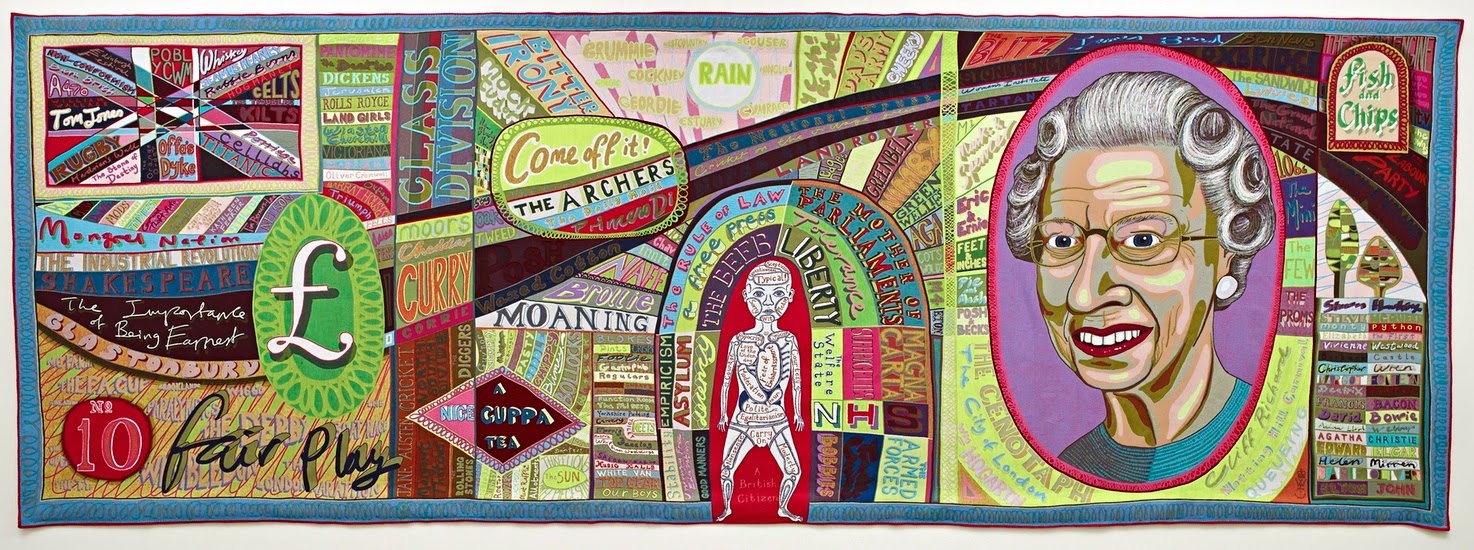
Grayson has portrayed himself as a map of days - a walled city, with things inside and outside the walls - a map that takes a long time to take in. He has portrayed the British with a huge, brightly coloured comfort blanket, with all the many things we love and identify with on it.
Grayson lived with the Jesus Army for sometime, observing how they have rescued people from their old self-destructive ways or life on the streets, to become a family in a shared house with a shared way of life. They sing in the evenings and instead of watching TV and they also share their money so he made their group portrait in the shape of a money box styled like a reliquary. Rather wittily it has "Jesus Saves" written at the top.
Another person who was going through an identity crisis was a man who was suffering from Alzheimer's disease, and this was also shattering for his wife. All their shared happy memories were disappearing. I loved the pot Grayson made them - the wife's scarf making a protection for them both, her face buried in his chest, perhaps with grief, and his face smiling - but vacantly, not understanding the nature of the problem.
You can see the exhibits here.
http://www.independent.co.uk/arts-entertainment/art/reviews/grayson-perry-who-are-you-national-portrait-gallery-review-sublimely-beautiful-9820710.html
This is on at the National Portrait Gallery, where the portraits are mostly rectangular objects with paint on them. But none of Perry's portraits are that. There were a lot of people looking at the Perry exhibits and talking about them with great animation and awe.
Grayson has portrayed himself as a map of days - a walled city, with things inside and outside the walls - a map that takes a long time to take in. He has portrayed the British with a huge, brightly coloured comfort blanket, with all the many things we love and identify with on it.
Grayson lived with the Jesus Army for sometime, observing how they have rescued people from their old self-destructive ways or life on the streets, to become a family in a shared house with a shared way of life. They sing in the evenings and instead of watching TV and they also share their money so he made their group portrait in the shape of a money box styled like a reliquary. Rather wittily it has "Jesus Saves" written at the top.
Another person who was going through an identity crisis was a man who was suffering from Alzheimer's disease, and this was also shattering for his wife. All their shared happy memories were disappearing. I loved the pot Grayson made them - the wife's scarf making a protection for them both, her face buried in his chest, perhaps with grief, and his face smiling - but vacantly, not understanding the nature of the problem.
You can see the exhibits here.
http://www.independent.co.uk/arts-entertainment/art/reviews/grayson-perry-who-are-you-national-portrait-gallery-review-sublimely-beautiful-9820710.html
 |
| We could have spent hours looking at this. |
Friday, 6 June 2014
How to Read Literature by Terry Eagleton part 2: Character in realist fiction vs modernist fiction
Here is Prof. E. writing about an important change in literature, and he makes the changes seem clear and easily understood. I have edited drastically taking out some of his examples:
So interesting, because one thinks that both views are true at the same time! Is that possible? I don't know about Bloom because one book I keep meaning to read is James Joyce's Ulysses. will I ever? When there are so many great books to read?
There was something I was going to write about and I forgot what it was before I had time to write it in my blog, and now I feel very cheated, because whatever it was is now lost forever. I do fear I have the dementia that comes from having too much to do in the way of dreary job tasks. But my mother's dementia is worse than it was, because she is confused about her money now, and I am afraid that she will start to give her small pot of money away to an undeserving cause. She will then forget she has done it and wonder what has happened.
One of the achievements of the great European realist novel, ... is to illustrate this weaving of character and context. Characters in this kind of fiction are seen as caught up in a web of complex mutual dependencies. they are formed by social and historical forces greater than themselves, and shaped by processes of which they may be only fitfully conscious. ... As George Eliot puts it, there is no private life that has not been influenced by a wider public one.
Characters in the realist tradition are generally presented as complex, credible, fully rounded individuals. Many of them seem a lot more real than the people next door.
The modernists are in search of new modes of characterisation, suitable to a post-Victorian age. ...The typical realist character tends to be reasonably stable and unified, ... As such, it reflects an era when identity was felt on the whole to be less problematic than it is today. People could still see themselves as the agents of their own destinies. they had a fairly acute sense of where they stopped and other people began. their personal and collective history, for all its ups and downs, seems to represent a coherent evolution, one which was more likely to issue in felicity than in catastrophe.
Modernism, by contract, pitches the whole concept of identity into crisis.... Once you start to see human consciousness as unfathomably intricate, it is hard to contain it within the well-defined limits of Walter Scott's Rob Roy or Robert Louis Stephenson's Jim Hawkins. Instead, it begins to spill out over the edges, seeping into its surroundings as well as into other selves....Woolf's fiction, where identity is more elusive and indeterminate than it is in Trollope or Thomas Hardy. ...It can involve a traumatic sense of loss and anxiety. Having too little identity can be quite as disabling as having too much.
If the self is bound up with its changing experiences, then it no longer has the unity and consistency of Bunyan's Everyman or Shakespeare's Coriolanus. It is less able to recount a coherent story of itself. Its beliefs and desires do not necessarily hang together to form a seamless whole. Neither do the works in which such characters appear.
T.S. Eliot is also disdainful of mere consciousness, and largely indifferent to individual personality. what seizes his attention are the myths and traditions which shape the individual self.... and these forces lie far below the individual mind, in a kind of collective unconscious. It is here that we all share in the same timeless myths and spiritual wisdom.
There is another reason why the idea of character as Balzac or Hawthorne knew it no longer seems feasible in modern times. This is because in an age of mass culture and commerce, human beings come to seem increasingly faceless and interchangeable. We can ... not distinguish easily between Vladimir and Estragon. ...Leopold Bloom ... is sharply individualised, yet he is also an anonymous Everyman whose thoughts and feelings could be almost anybody's. His mind is magnificently banal.
So interesting, because one thinks that both views are true at the same time! Is that possible? I don't know about Bloom because one book I keep meaning to read is James Joyce's Ulysses. will I ever? When there are so many great books to read?
There was something I was going to write about and I forgot what it was before I had time to write it in my blog, and now I feel very cheated, because whatever it was is now lost forever. I do fear I have the dementia that comes from having too much to do in the way of dreary job tasks. But my mother's dementia is worse than it was, because she is confused about her money now, and I am afraid that she will start to give her small pot of money away to an undeserving cause. She will then forget she has done it and wonder what has happened.
Friday, 15 March 2013
A happy day
Today I didn't have to teach or do anything much, so I started by going on a long walk by the river with my daughter's school. I parked in the road where I grew up, outside my friend's house, and I was so glad to be active again after a week sitting at my desk, in the car, or in the classroom. I whizzed along as fast as my shoes would allow. But my shoes are rigid walking shoes and though good at protecting the feet, they are not flexible enough for fitness walking and I know my feet will ache tomorrow.
There were signs of spring by the river - a small bunch of violets growing in the Rivermount steps, a few shivering daffs, catkins. After 2 hours my legs were really tired and I was glad to stop. Then I took the knitwear that I had bought in the sale back to the shop. I went and had coffee and a cake with my mum who had a lot to say about hospitals and the way they treat old people, and dementia. Sometimes I think my mum has dementia but there was not the slightest trace of it today.
I got back and looked at my emails and finished my book and wrote a book review. Then my daughter told me that a boy had asked her on a date to a coffee shop and I took her on her date. She met the boy, who looks like a decent sort of lad and is a lot taller than she is. Obviously he knows a good thing when he meets one, and apparently he can run fast. I think that it is a good thing that he can be bothered to run fast, but I haven't really thought this through...
There were signs of spring by the river - a small bunch of violets growing in the Rivermount steps, a few shivering daffs, catkins. After 2 hours my legs were really tired and I was glad to stop. Then I took the knitwear that I had bought in the sale back to the shop. I went and had coffee and a cake with my mum who had a lot to say about hospitals and the way they treat old people, and dementia. Sometimes I think my mum has dementia but there was not the slightest trace of it today.
I got back and looked at my emails and finished my book and wrote a book review. Then my daughter told me that a boy had asked her on a date to a coffee shop and I took her on her date. She met the boy, who looks like a decent sort of lad and is a lot taller than she is. Obviously he knows a good thing when he meets one, and apparently he can run fast. I think that it is a good thing that he can be bothered to run fast, but I haven't really thought this through...
Subscribe to:
Posts (Atom)