Showing posts with label modernism. Show all posts

Tuesday, 29 July 2014

How to read literature by Terry Eagleton ( part 3) - Plot in Classical realism vs. modernism

"For classical realism, the world itself is story-shaped. In a lot of modernist fiction, by contrast, there is no order apart from what we ourselves construct. And since any such order is arbitrary, so are fictional openings and endings. There are no divinely ordained origins or natural closures. which is to say that there are no logical middles either. ...
"Some modernist works are thus sceptical of the while notions of narrative. Narrative suggests that there is a shapeliness to the world, an orderly procession of causes and effects. It is sometimes (though by no means always) bound up with a faith in progress, the power of reason and the forward march of humanity. It would not be too fanciful to claim that narrative of this classical kind fell to pieces on the battlefields of the First World War, an even which scarcely fostered a faith in human reason. It was around these years that the great modernist works were produced, from Ulysses and The Waste Land to Yeats's The Wild Swans at Coole and Lawrence's Women in Love. For the modernist mind, reality does not evolve in a tidy fashion. Event A may lead to event B, but it also leads to events C, D, E and countless others. it is the product of countless factors as well. Who is to decide which of these storylines should take priority? Whereas realism views the world as an unfolding, modernism test to see it as a text. The word "text" here is akin to "textile", meaning something spun of many interwoven threads. ...less a logical development than a tangled web... You cannot pinpoint where it begins or ends....
"So the idea of narrative is thrown into crisis. For modernism, knowing where something began, even if this were possible, will not necessarily yield you the the truth about it. To assume so is to be guilty of what has been called the genetic fallacy. There is no one grand narrative, simply a host of mini-narratives, each of which may have its partial truth. ..To narrate is to falsify. In fact, one might even claim that to write is to falsify. Writing, after all, is a process which unfolds in time, and in this respect resembles narrative. The only authentic literary work then, would  be one which is conscious of this falsification, and which tries to tell its tale in a way that takes it into account.
"That is to say that all narratives must be ironic. They must deliver their accounts while keeping their own limitations constantly in mind. They must somehow incorporate what they do not know into what they know. ... Narratives must find a way of suggesting that there could be many versions of their subject-matter beside their own. If they are not to appear deceptively absolute, they must point to their own arbitrariness."
This helps us to understand and appreciate what Ian McEwan is trying to do in any of his novels but perhaps "Sweet Tooth" most of all, and it helps us to understand what Sterne is doing in Tristram Shandy. Also I noticed it in Doctor Who recently (episode by Mark Gatiss).

Terry Eagleton part 1

Terry Eagleton part 2

Friday, 6 June 2014

How to Read Literature by Terry Eagleton part 2: Character in realist fiction vs modernist fiction

Here is Prof. E. writing about an important change in literature, and he makes the changes seem clear and easily understood. I have edited drastically taking out some of his examples:
One of the achievements of the great European realist novel, ... is to illustrate this weaving of character and context. Characters in this kind of fiction are seen as caught up in a web of complex mutual dependencies. they are formed by social and historical forces greater than themselves, and shaped by processes of which they may be only fitfully conscious. ... As George Eliot puts it, there is no private life that has not been influenced by a wider public one.
 Characters in the realist tradition are generally presented as complex, credible, fully rounded individuals. Many of them seem a lot more real than the people next door. 
The modernists are in search of new modes of characterisation, suitable to a post-Victorian age. ...The typical realist character tends to be reasonably stable and unified, ... As such, it reflects an era when identity was felt on the whole to be less problematic than it is today. People could still see themselves as the agents of their own destinies. they had a fairly acute sense of where they stopped and other people began. their personal and collective history, for all its ups and downs, seems to represent a coherent evolution, one which was more likely to issue in felicity than in catastrophe.  
 Modernism, by contract, pitches the whole concept of identity into crisis.... Once you start to see human consciousness as unfathomably intricate, it is hard to contain it within the well-defined limits of Walter Scott's Rob Roy or Robert Louis Stephenson's Jim Hawkins. Instead, it begins to spill out over the edges, seeping into its surroundings as well as into other selves....Woolf's fiction, where identity is more elusive and indeterminate than it is in Trollope or Thomas Hardy. ...It can involve a traumatic sense of loss and anxiety. Having too little identity can be quite as disabling as having too much.
If the self is bound up with its changing experiences, then it no longer has the unity and consistency of Bunyan's Everyman or Shakespeare's Coriolanus. It is less able to recount a coherent story of itself. Its beliefs and desires do not necessarily hang together to form a seamless whole. Neither do the works in which such characters appear. 
T.S. Eliot is also disdainful of mere consciousness, and largely indifferent to individual personality. what seizes his attention are the myths and traditions which shape the individual self.... and these forces lie far below the individual mind, in a kind of collective unconscious. It is here that we all share in the same timeless myths and spiritual wisdom.
There is another reason why the idea of character as Balzac or Hawthorne knew it no longer seems feasible in modern times. This is because in an age of mass culture and commerce, human beings come to seem increasingly faceless and interchangeable. We can ... not distinguish easily between Vladimir and Estragon. ...Leopold Bloom ... is sharply individualised, yet he is also an anonymous Everyman whose thoughts and feelings could be almost anybody's. His mind is magnificently banal.

So interesting, because one thinks that both views are true at the same time!  Is that possible? I don't know about Bloom because one book I keep meaning to read is James Joyce's Ulysses. will I ever? When there are so many great books to read?

There was something I was going to write about and I forgot what it was before I had time to write it in my blog, and now I feel very cheated, because whatever it was is now lost forever. I do fear I have the dementia that comes from having too much to do in the way of dreary job tasks. But my mother's dementia is worse than it was, because she is confused about her money now, and I am afraid that she will start to give her small pot of money away to an undeserving cause. She will then forget she has done it and wonder what has happened.

Wednesday, 24 July 2013

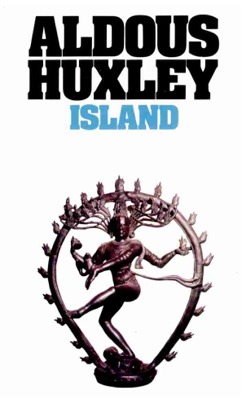
Aldous Huxley - the Island

I have been reading this book for about 6 weeks. This is because it isn't a novel, more like a long lecture by someone who considers himself incredibly wise, and you are not allowed to argue (of course!), instead you have a proxy whose name is Will who asks constantly for more information.


Will arrives by accident on an idyllic island where the people are  working towards enlightenment pretty much in the Buddhist tradition, but with Hinduism thrown in, and yoga. They aim to be the most developed humans they can be, fully aware of the oneness of spirituality in the world and in themselves. It's Westernised in that the people speak English and have a certain amount of industry, but no desire for any quantity of material possessions, and they have no aggression, (this is educated out of them) so they can't defend themselves. Will is taken on a tour by various wise people, male and female, who tell him all about their values and their way of life.

Unfortunately, Will has boring sexual guilt and Huxley is probably the only person who can bear him droning on about his experiences with his good wife and his "vulgar" but incredibly sexually skillful girlfriend. Huxley was one of the modernists who was unable to adjust to the rise of the masses, and he tends to contrast his imagined world with the constraints of the social world in which he grew up, which dates his attitudes. The other characters are sketches that give voice to Huxley's ideas and opinions - and their reverse, as counterpoint. So they are not characters in the true sense of the word.

Most of Huxley's ideas are terrific. On the island, there is an openness about family life that allows children to access other parents as well as their own, which lessens the possibility of damage done by family neuroses. People are encouraged to attend to the here and now, and enjoy living in the moment. Everyone has to do manual labour for two hours a day, so they don't become "sitting addicts" like Western people. Overproduction of fresh food is kept in a huge communal freezer. Electricity comes from harnessing the rivers.

But Huxley does advocate eugenics - frozen sperm of talented men (and eggs of women?) are used to create a more talented race - this is encouraged and preferred but not compulsory. Huxley is a gene snob. It does mean that many of the population are closely related, but Huxley doesn't acknowledge this problem.

A difficult personality that doesn't fit in? Huxley divides these into "Muscle Men [and women]" (example: Stalin, has a love of power and domination) and "Peter Pans" (common, but Hitler is the example). These can both be treated by special coaching and become useful and happy members of society. All well and good except where Huxley announces that they can check the diagnosis of "Peter pans" by x-raying the bones of the wrist. Uuuuuhhhh??? Huxley is absolutely sure that there are some physical types that are "potential failures and criminals, potential tyrants and sadists, potential misanthropes and revolutionaries for revolution's sake" and that they need to be pinpointed early and given appropriate treatment.

In fact, the island is a lovely idea except for the lack of individualism in the people. I do agree with him that people should not be either educated to serve the state, or educated to become greedy for gewgaws and novelties, and cogs in capitalist enterprise; and I think that his ideal aim of education, which is to develop as fully rounded and spiritually happy an individual as possible, is a model that is crying out to be tried.

Such a society is not sustainable, and the ending is not a happy one, but it is a likely one.

As a novel it's a chore. I am amazed how many people give it an Amazon score of 5 stars!